
Trees are the slowest-moving part of any property, which is exactly why they get overlooked. A building shows a problem within days; a tree can decline for years before anything obvious appears above ground. By the time the canopy thins or a limb drops, the underlying cause has usually been developing for a long time. Most of what tree maintenance involves is unglamorous and cheap, and almost all of it happens at ground level rather than up in the branches.
Protect the Root Zone
The single most valuable thing you can do for an established tree is leave its roots alone. Most feeding roots sit in the top half-metre of soil and extend well beyond the canopy edge often to twice the crown radius. Vehicles parked over that area compact the soil and cut off air and water. Trenching for services severs structural roots and destabilises the whole tree. Raising the soil level with fill or paving suffocates roots that need to breathe. Marking a protection zone before any construction, landscaping or excavation prevents the damage that no later treatment can undo.
Mulch, But Do It Correctly
A layer of organic mulch spread over the root zone is close to a free upgrade. It moderates soil temperature, retains moisture, suppresses competing grass and adds organic matter as it breaks down. The technique matters though. Mulch should form a flat layer roughly five to eight centimetres deep, spread outward toward the canopy edge and kept clear of the trunk itself. Piling it against the bark traps moisture, encourages rot at the collar and invites pests a mistake so common it has its own nickname among arborists.
Water Deeply and Infrequently
Watering habits shape root architecture. Light frequent sprinkling encourages shallow roots that dry out at the first hot spell and provide poor anchorage. Deep, infrequent soaking drives roots downward, producing a more drought-resilient and stable tree. Newly planted specimens need consistent attention through their first two to three years while they establish. Mature trees generally cope on their own except during extended dry periods, when a slow soak over several hours serves them far better than a daily spray.
Inspect on a Schedule
A walk-around twice a year, plus a check after any severe storm, catches most developing problems early. Look at the trunk for cracks, cavities, seeping fluid, loose bark and fungal fruiting bodies. Look at the base for soil heaving or cracking that indicates root plate movement. Look up for deadwood, hanging limbs, and forks where bark appears trapped between two stems. Compare canopy density with previous years gradual thinning is easy to miss without photographs. A routine built around these inspections keeps small defects from becoming structural failures.
Prune With Purpose
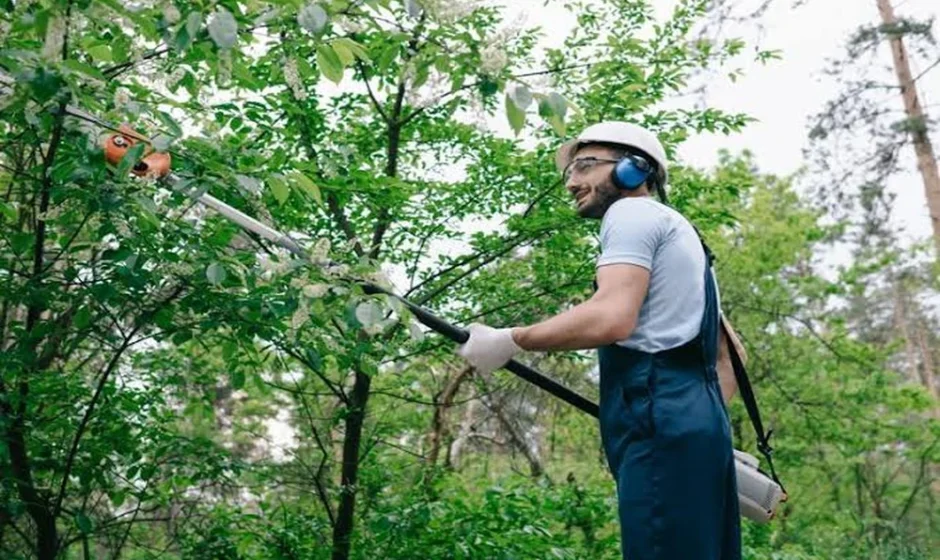
Cutting without a clear objective usually does more harm than good. Legitimate reasons include removing dead or diseased wood, eliminating branches that rub against each other, clearing structures and access routes, and shaping young trees so they develop sound branch structure. Cuts belong just outside the branch collar, never flush to the trunk and never leaving a long stub. Avoid removing more than a quarter of the living canopy in one season. Never top a tree the dense weak regrowth that follows is more hazardous than whatever you were trying to fix. Guidance on well-timed tree pruning covers how frequency and season affect recovery.
Watch for Pest and Disease Signals
Early indicators are subtle. Small holes in bark with sawdust-like frass suggest boring insects. Sticky honeydew on leaves and surfaces below points to sap-feeding pests. Discoloured leaves in a defined pattern, premature leaf drop, or dieback progressing from the branch tips inward all warrant attention. Termites and fungal decay often work invisibly inside the stem while the exterior looks acceptable. Photographing symptoms and noting when they appeared helps considerably when an arborist assesses the tree, since progression over time is more informative than a single snapshot.
Manage What Grows Around the Tree
Ground-level conditions influence tree health more than most people expect. Grass growing right up to a trunk competes for water and nutrients, and mower and strimmer damage to bark at the base is a frequent cause of decline repeated wounding at the collar interrupts the tissue the tree relies on to move sugars. Keeping a mulched, grass-free ring around the base removes both problems at once. Coordinating this with the regular grass cutting service ensures machinery operators know to keep clear rather than trimming as close as possible.
Plan for Species and Site
Long-term health depends on choices made at planting. A species that will reach twenty metres does not belong three metres from a house, and no amount of pruning will resolve that mismatch it only creates a permanent maintenance burden and a progressively weaker tree. Consider mature height and spread, root behaviour, tolerance of local soil and exposure, and proximity to services and structures. Getting this right at planting saves decades of remedial work.
Know When to Bring in Help
Handle the ground-level work yourself and hand over anything requiring height, powered saws near structures, or diagnosis of internal decay. An arborist can assess sound wood using specialist testing without felling the tree, which often shows that a specimen assumed to be dangerous is in fact retainable. That assessment is worth having before making an irreversible decision about a tree that took thirty years to grow.